Introduction
For wholesalers, distributors, importers and professional repair businesses, comparing incell vs oled is not only about display technology. The choice affects purchase cost, repair pricing, inventory turnover, warranty risk and the type of customers a business can serve.
Incell LCD screens are commonly used as an economical replacement option, while OLED screens are usually selected when display quality and a closer-to-original viewing experience are more important. For B2B buyers, the practical question is not which technology is universally better, but which option fits the phone model, local market and target repair tier.
1. Incell vs OLED: What Is the Difference?
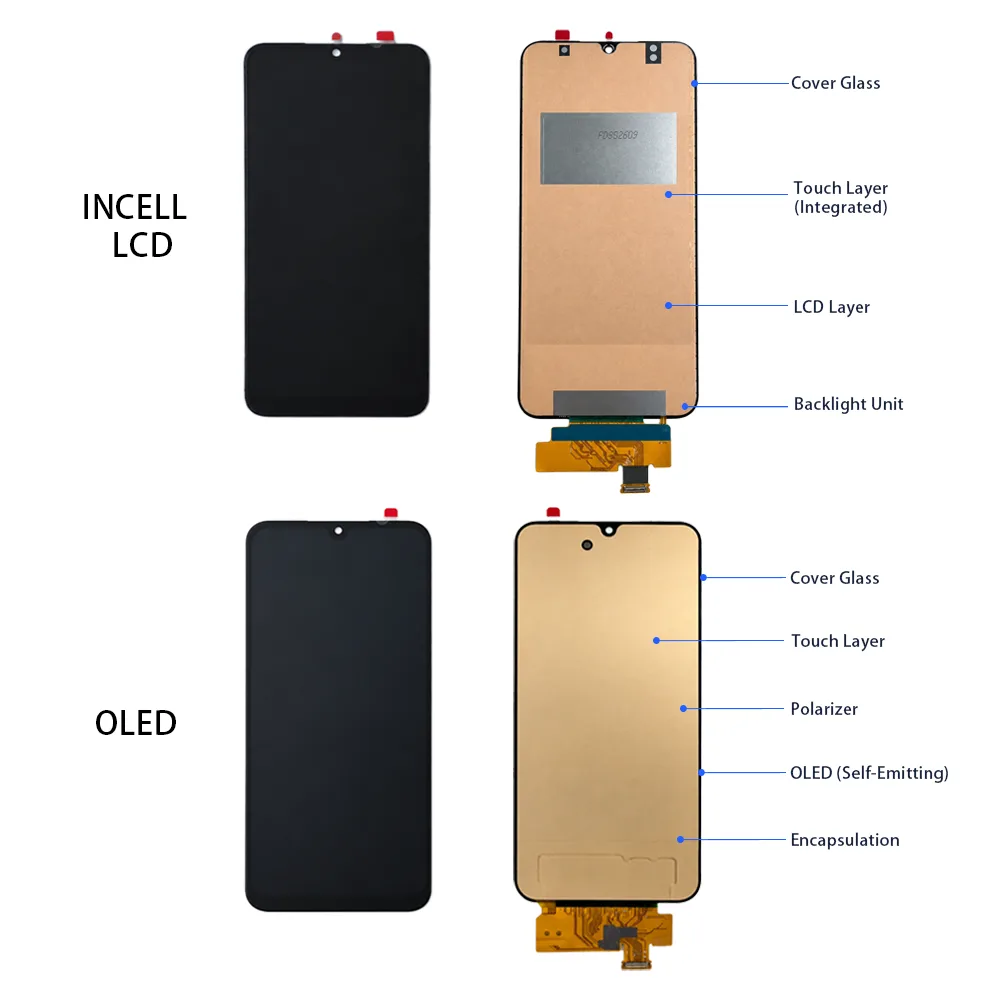
The main difference is how the display creates an image. Incell is an LCD-based solution that still uses a backlight, while OLED pixels emit their own light. This difference affects black level, contrast, thickness, power behavior and cost.
1.1 What Is an Incell Screen?
Incell is an LCD technology in which the touch sensor is integrated into the LCD cell. Compared with older LCD structures, this helps reduce assembly thickness and can provide stable touch performance when the panel, IC and lamination process are well controlled.
In the repair market, Incell screens are widely used as cost-effective replacements for many iPhone screens and Android phone screens They are particularly useful when customers want a functional repair at a lower price than an OLED replacement.
1.2 What Is an OLED Screen?
OLED stands for Organic Light Emitting Diode. Each pixel produces its own light, so the display does not require a traditional LCD backlight. This allows OLED screens to achieve true blacks, higher contrast and, in many designs, a thinner display structure.
In the replacement market, OLED products may differ by construction, sourcing category and quality level. Soft OLED and Hard OLED describe panel construction, while terms such as original pulled or refurbished OLED describe product origin or condition. Buyers should confirm exactly what a supplier means by each grade before comparing quotations.
2. Incell vs OLED: Key Differences
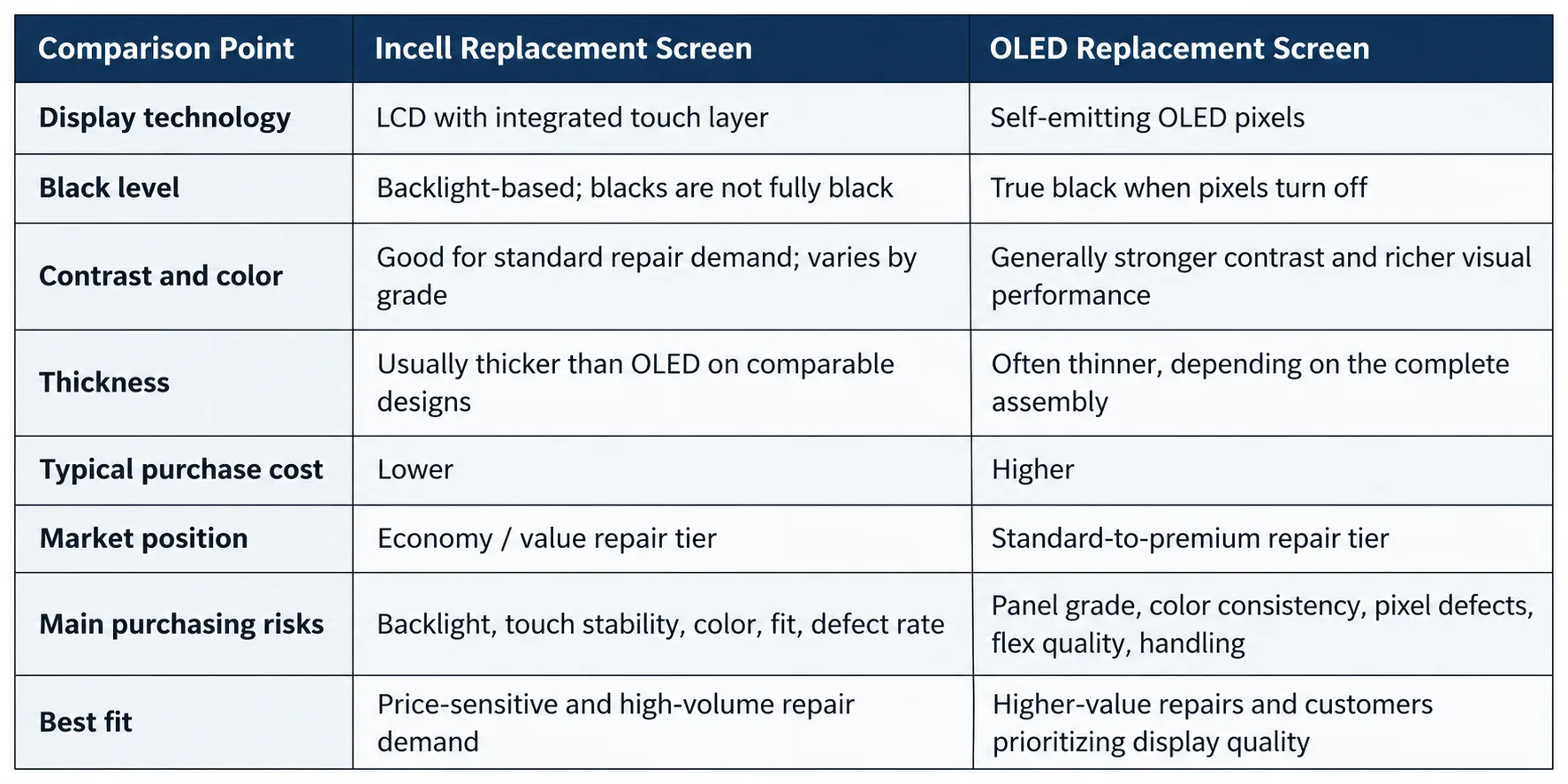
The table is useful for selecting a product tier, but the technology name alone does not determine final quality. A high-grade Incell can be more consistent than a low-grade OLED in some areas, so buyers should compare actual samples, specifications and batch performance rather than judging only by the display category.
2.1 Display Quality and Structure
OLED has the clearest visual advantage in black level and contrast because pixels can switch off individually. Incell remains suitable for standard daily use, but its backlight means black areas are not truly black. Brightness, color temperature, touch response and viewing quality still depend heavily on the specific panel and manufacturing process for both types.
2.2 Cost and Market Positioning
Incell normally gives repair businesses more room to compete on price. OLED requires a higher purchase budget but can support a higher-value repair service. For B2B buyers, the more useful comparison is total margin after defects, returns and warranty costs—not unit price alone.
3. Which Screen Fits Different Repair Markets?
3.1 Budget Repair Channels
Incell is usually the better fit when customers mainly compare repair prices, the device is older, or the local market has strong price sensitivity. It gives repair shops an economical screen tier without moving directly to a premium OLED cost level.
3.2 Premium Repair Services
OLED is generally more suitable for higher-value devices and customers who expect stronger contrast, deeper blacks and a display experience closer to the original OLED-equipped phone. The exact OLED grade still matters, so buyers should separate Soft OLED, Hard OLED and other sourcing categories instead of treating all OLED products as equivalent.
3.3 Wholesalers and Distributors
For many wholesalers, carrying both Incell and OLED is more practical than choosing only one. Incell can cover fast-moving economy demand, while OLED can serve customers looking for higher-grade repairs. The stock ratio should be based on model demand, local pricing and historical warranty data.
For larger-volume purchasing or distributor programs, buyers can also review WOSENTE’s wholesale business service for B2B order support.
4. What B2B Buyers Should Check Before Bulk Ordering
4.1 Display and Touch Quality
- Brightness and color consistency
- Full-screen touch response and edge touch
- Dead pixels, bright spots and display uniformity
- Backlight leakage for Incell LCD
- Black display performance and panel uniformity for OLED
4.2 Fit and Compatibility
Confirm the exact phone model, frame option, connector position, screen dimensions and any model-specific sensor or touch requirements. A screen can look good on a tester but still create installation problems if mechanical fit is inconsistent.
4.3 Batch Consistency
A good sample does not guarantee that a full shipment will perform the same. For bulk purchasing, consistency across brightness, color, touch response, cosmetic finish and defect rate is more important than one perfect sample. Ask how the supplier controls incoming materials, in-process testing and final inspection.
When evaluating supplier standards, review the mobile phone parts quality-control process and compare the stated checks with your own acceptance requirements.
4.4 Packaging, Warranty and After-Sales
Screen quality can be affected by handling as well as manufacturing. Buyers should confirm protective packaging, carton arrangement, transport protection, warranty terms and the process for identifying and replacing defective units.
For importers and distributors, WOSENTE’s Packaging & Fulfillment page can be linked here because this section discusses packing and order handling.
5. WOSENTE Screen Supply and Quality Control
WOSENTE supplies replacement phone screens for wholesalers, distributors, importers, refurbishers and professional repair businesses. Available configurations vary by brand and model and can include Incell LCD, Hard OLED, Soft OLED, with-frame and without-frame options.
For B2B orders, screen inspection can include display checks, touch testing, appearance inspection, fit verification and batch-level quality control according to the product type and order requirements. Buyers should provide the exact model list, preferred screen grade, frame requirement and quantity before quotation so that the correct configuration can be confirmed.
6. Frequently Asked Questions
6.1 Is Incell Better Than OLED?
Not universally. Incell is usually better for cost-sensitive repairs, while OLED is generally better when display performance and premium positioning matter more. The right choice depends on the device model, customer expectations and target repair price.
6.2 Should Wholesalers Stock Both?
In many markets, yes. Carrying both allows a distributor to serve economy and premium repair demand without forcing every customer into the same price tier.
6.3 What Should Buyers Test First?
Start with display consistency, touch response, fit and defect rate. These factors have the most direct effect on installation success, returns and customer complaints. For refurbished or pulled OLED panels, also inspect for existing image retention or burn-in before approving the batch.
7. Conclusion
The Incell vs OLED decision should be based on business use rather than one simple “better or worse” judgment. Incell is a practical choice for budget repairs and high-volume price-sensitive demand. OLED is better suited to higher-value repairs where display performance and premium positioning justify a higher purchase cost.
For wholesalers and repair businesses, the strongest approach is usually to build clear product tiers, verify sample quality and monitor batch consistency before scaling an order. Purchase price matters, but defect rate, warranty handling, fit, packaging and customer expectations ultimately determine real profit.
To check model availability or request a B2B quotation, use the Contact Us page and provide your model list, screen type and required quantities.